
Quick answer
CHED stands for Common Health Entry Document, on Swedish health import document. It is the mandatory prior notification that the importer or representative fills in the EU system TRACES NT when a shipment is subject to border control, i.e. when it contains animals, animal products, plants or certain food and feed from countries outside the EU.
There are four types (CHED-A, CHED-P, CHED-PP and CHED-D). The shipment should normally be notified in advance at least a working day before arrival in EU territory, and the CHED must be approved before the goods leave the port or airport and before the customs declaration is submitted. The reference number is then entered in the import declaration as supporting document.
In this guide
An incorrect CHED is one of the most expensive things that can happen to a food import. The goods remain at the terminal, the cold chain is ticking, and in the worst case, the shipment has to be rejected. At Tullify, we create and review health entry documents every week, both for animal consignments and for plant goods under strict import control. This guide is written based on how it actually works in TRACES NT and in the import declaration, not just based on the legal text.
What is CHED?
CHED (Common Health Entry Document) is the EU's common health entry document. It is three things at the same time:
- A pre-registration. You tell the border control station that a shipment subject to border control is on its way, what it contains and when it will arrive.
- A control decision. The authority documents its document, identity and physical checks in the same document and approves or rejects the shipment.
- A supporting document at customs. The reference number from the approved document is entered in the import declaration, and Swedish Customs checks the status digitally against TRACES.
The plot is created in TRACES NT (TRAde Control and Expert System, New Technology), the European Commission's platform for import documents and certificates. A reference number has the format CHEDP.SE.2026.0012345, where the middle part is the country where the border control takes place.
The act replaced the previous CVED (animal products and animals) and CED (non-animal food and feed). If you see these terms in an old routine or instruction, it is not up to date.
The four CHED types
The type you use depends on the product, not the mode of transport. If you choose the wrong type, you will have to start over, as a submitted document cannot change type.
Live animals
Live animals entering the EU, such as horses, cattle, poultry and pets in commercial import.
- Authority
- Swedish Board of Agriculture
- Common at
- Horse and breeding imports
Animal products
Meat, fish, dairy, honey, gelatin, animal by-products and compound foods containing animal ingredients.
- Authority
- The National Food Administration
- Document code
- N853
Plants and plant products
Plants, fruit, vegetables, wood products, wood packaging and used agricultural machinery, i.e. goods with plant protection requirements.
- Authority
- Swedish Board of Agriculture
- Document code
- C085
Strict control, non-animal
Food and feed of non-animal origin subject to temporary increased control or emergency measures, such as peanuts, spices and certain sauces.
- Authority
- The National Food Administration
- Document code
- C678
A shipment may require two documents. A compound food with both animal content and an ingredient under strict control may require two documents, and organic goods also require an approved COI certificate to be linked to the document in TRACES NT. Review each item individually, not the shipment as a whole.
When is CHED required?
CHED is required when the goods are subject to border control when imported from a country outside the EU. Simply put:
- Animal foods and animal by-products, regardless of quantity in commercial import.
- Composite foods with animal content (composite products).
- Live animals and breeding material.
- Plants, plant products and goods with plant protection requirements.
- Non-animal food and feed that are on the list for reinforced control or subject to emergency measures.
- Kitchenware and tableware made of melamine or polyamide plastic originating in or consigned from China or Hong Kong, as per Regulation (EU) No 284/2011. They require an approved CHED-D prior to customs clearance, and the deadline for this is at least two working days in advance.
It is normally required not in the following cases:
- Goods in free circulation that have already undergone border control in another EU country, provided that the control has been completed and the document approved.
- Goods without health or plant protection requirements, such as clothing, electronics or machinery without soil residues.
- Private imports within the applicable exemption for travelers' personal luggage.
If you are unsure whether your goods are subject to border control, the commodity code is the deciding factor. We will go over this in our guide on commodity code classification and in the article about import of food to Sweden.
How to create a CHED in TRACES NT, step by step
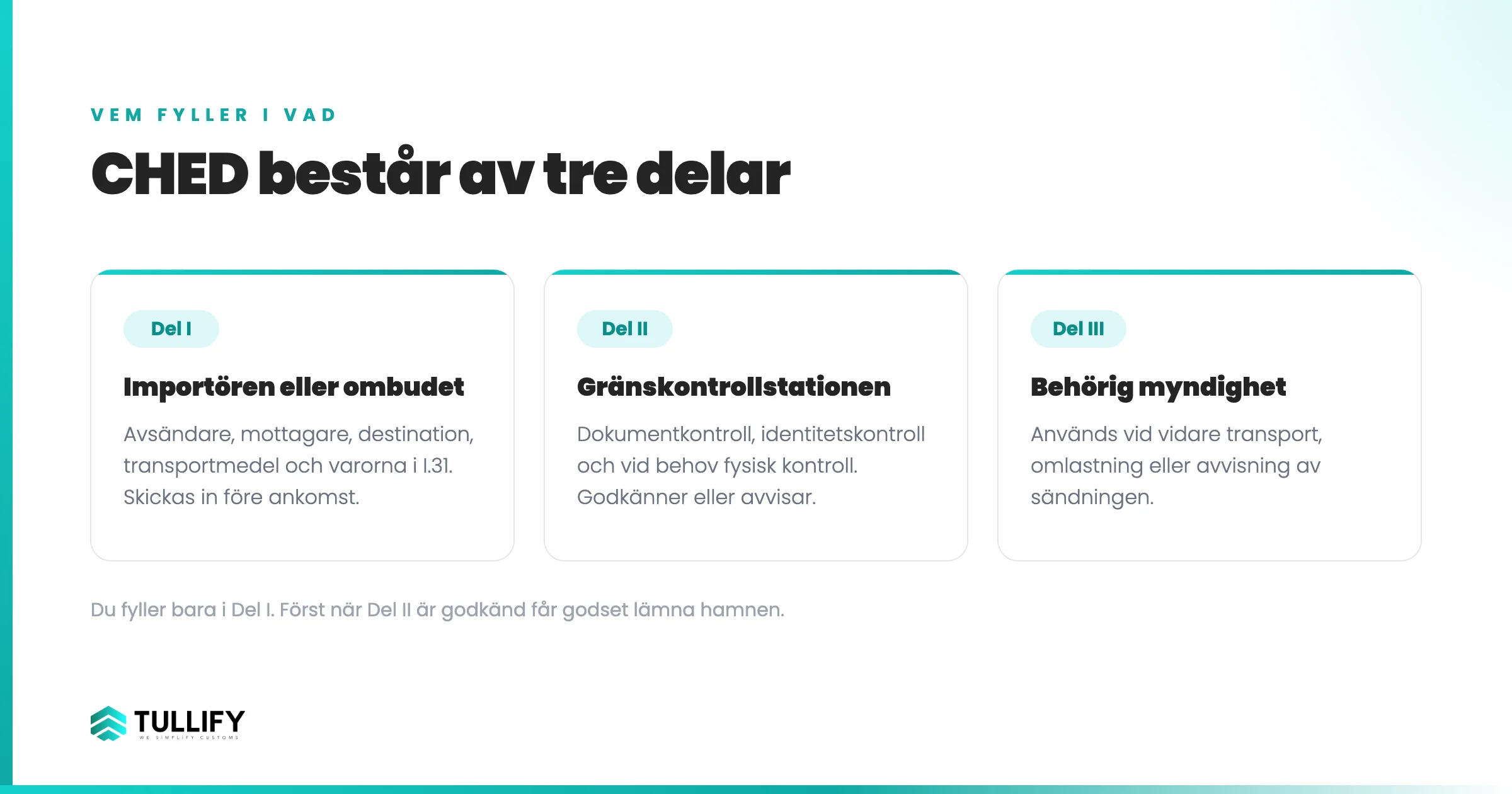
The document consists of three parts. As an importer or agent, you only fill in Part I. Part II is filled in by the authority at the border control station and Part III is used for onward transport or rejection.
The chain from health certificate to customs declaration: the certificate is issued in the country of dispatch, Part I is pre-notified in TRACES NT at least one working day before arrival, the border inspection post carries out document, identity and, if necessary, physical checks, and only when the CHED is approved can the goods leave the port and the declaration be submitted.
-
Get access to TRACES NT
You log in with an EU Login account and request the role of actor (Responsible for the consignment) for your company. An agent can act for the importer, but the role must be in place before the first shipment. The application is approved by the competent authority, so start well in advance.
-
Gather the information before you start filling in.
You need the health certificate or health certificate, invoice, packing list, transport document (CMR, sea waybill or air waybill), container number or trailer registration number, seal number and destination information. If the batch number or net weight is missing: get them from the certificate and manifest, never guess.
-
Fill in Part I: sender, recipient and destination
The consignor (I.1) must match the health certificate. The consignee (I.6) is the person who physically receives the goods, which is often the warehouse or terminal and not the legal entity listed on the invoice. The establishment of destination (I.7) and the operator must be registered in TRACES.
-
Specify transportation and arrival
Means of transport (I.13), seal and container number, and estimated time of arrival at the border inspection post (I.15). I.15 refers to the arrival at the border inspection post. However, the deadline for the prior notification itself is counted towards the arrival of the consignment in EU territory, and also applies to consignments that have been transhipped within the EU.
-
Describe the goods in I.31
CN code, product description, country of origin, number of packages, net and gross weight and batch number per product line. This determines whether the customs declaration will go through, as the net weight and product code must match exactly between the document and the declaration.
-
Attach certificates and submit
Upload the health certificate or health certificate, and for Swedish shipments, state the attestation number (PA number). For British certificates, use the certificate reference number instead. Book the inspection according to the border inspection station's routine and submit Part I.
-
Wait for approval in Part II
The border control station performs document checks, identity checks and, if necessary, physical checks and sampling. Only when the status is approved (Validated) can the goods leave the port or airport and only then should the customs declaration be submitted.
Deadlines that actually apply
| Moment | Deadline | Comment |
|---|---|---|
| Advance registration | At least one working day before arrival in EU territory | Can be shortened to at least four hours if arrival cannot be known one working day in advance for logistical reasons. |
| The approval | Before the goods leave the port or airport | Shipments that are moved within the EU without border control are normally rejected. |
| Customs declaration | After passing CHED | Customs checks the status digitally and only releases approved shipments. |
| Road transport from third countries | Upon first entry into the EU | Border control takes place in the first EU country, not in Sweden. This also applies to flights that are transferred to a car in another EU country. |
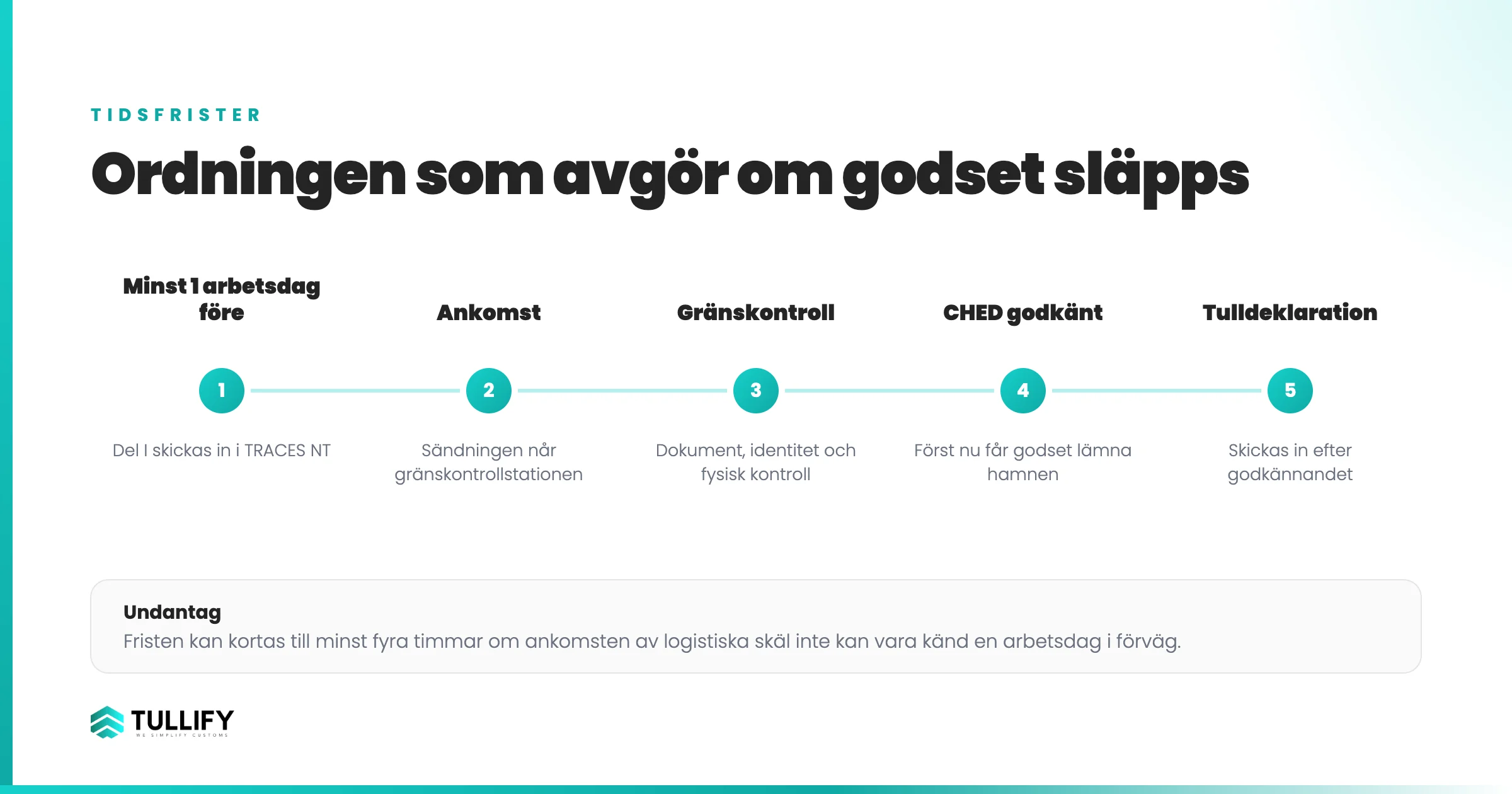
The Swedish National Food Agency tightened its tone in June 2026. The authority explicitly reminded that consignments subject to border control may not leave the border control station area before the CHED is approved in TRACES NT, and that the CHED and COI must be approved before the consignment is reported to Customs. Consignments entering the country without an approved CHED must normally be rejected.
CHED in the import declaration
The approved number is listed among supporting documents, data elements 12 03 000 000 in the Swedish Customs declaration guide. The reference number itself is added in 12 03 001 000 and the document code in 12 03 002 000, where the codes are taken from the Customs Tariff. The Swedish Customs is clear on one point: when the goods are covered by a common health document for import, the information must be entered on item level. The same reference number may not appear at both the main level and the item level.
| Action | Document code | Reference |
|---|---|---|
| CHED-P (animal products) | N853 | CHEDP.SE.2026.0012345 |
| CHED-D (tightened control, non-animal) | C678 | CHEDD.SE.2026.0012345 |
| CHED-PP (plants and plant products) | C085 | CHEDPP.SE.2026.0012345 |
If the shipment is organic, the item needs two codes: the one that belongs to the product itself, and C644 for the inspection certificate. So it's not either or.
Always check the code requirement against the Customs Tariff for your particular commodity code before you declare. The conditions vary between commodity codes, and a missing or incorrect code selection is one of the most common reasons why a declaration gets stuck.
Five rules that determine whether the declaration is successful:
- Net weight and product code must match between the document and the declaration. Deviations stop the transmission.
- The product lines must correspond to the product items. If the document has four lines, the declaration should normally have four corresponding entries.
- Organic and conventional must not be mixed together on the same item, even if the item code is identical.
- Has the document been replaced in TRACES? Please enter the reference number of the replacement, approved document, never the original one.
- Is the shipment split? For multiple destinations or sub-consignments, enter the number that applies to each sub-consignment. A COI certificate must be divided into extracts in TRACES.
If you need help with the declaration itself, there is more about the structure on our pages about import declaration and customs clearance.
CHED, COI, health certificate and health certificate
The terms are often confused, and this is the most common reason why an importer thinks the paperwork is complete when it is not. The certificate and the notification are two different things, and you need both.
| Action | What it is | Who issues it? |
|---|---|---|
| Health certificate | Proof that the animal product meets EU requirements | Competent authority in the country of dispatch |
| Health certificate | Plant health certificate for plants and plant products | Plant protection agency of the sending country |
| CHED | Prior notification and the authority's inspection decision | You fill in Part I, the authority Part II |
| COI | Inspection certificate for organic products | Control body in the sending country |
The certificate is the prerequisite and the notification is the tool. Without a certificate, Part I cannot be completed correctly, and without an approved Part II, the goods may not leave the port even if the certificate is error-free. For Swedish shipments, the certificate is identified by the attestation number, for British shipments by the certificate reference number.
Organic goods require both tracks at the same time: an approved COI linked to the health entry document in TRACES NT, and the code C644 in the declaration alongside N853, C678 or C085.
Customs warehouse, free zone and further transport
Border control is not linked to the goods going directly into free circulation. If the shipment is to be sent to a free zone, free warehouse, customs warehouse or shipping trade, or further in transit, it must still be border controlled and the document approved. The fact that the goods are to be stored or transited is therefore no exception.
For further transport, Part III is used. There, the authority documents that the shipment is to be moved to another destination, reloaded or rejected. If you plan to move the goods to a customs warehouse after the inspection, this must be stated in the notification from the beginning, not as a subsequent change.
One thing that is often missed: the check takes place at the first border control station in the EU, not where you clear customs. If the goods arrive by plane to another member state and are loaded onto a car for further transport to Sweden, they must be checked at the airport's border control station before the car drives on. If it rolls into Sweden without being checked, it will normally be rejected, no matter how correct your Swedish declaration is.
Common pitfalls, from our own cases
These are errors we see recurring in practice. They are rarely mentioned in the manuals.
- Trailer exchange after notification has been submittedIf the freight forwarder changes the trailer after the certificate and document have been issued, it is not enough to update the field. In one of our cases in July 2026, the Swedish Food Administration said that the change requires new health certificates and new CHEDs, since the trailer number is on the certificate. However, a pure seal deviation has been able to be handled without new documents. Plan the transport so that the vehicle is locked before the certificate is issued.
- The cold storage is a different facilityWhen the goods pass through a cold store before the destination, the cold store is its own origin facility in TRACES, with the activity for cold store. If you select the wrong facility, the document will be incorrect even if the address looks correct.
- The recipient is the warehouse, not the companyI.6 should be the one who physically receives the shipment. Filling in the parent company instead of the receiving warehouse is one of the most frequent correction requests we see.
- Approved but the goods remainApproval is not always enough for the terminal to release the goods. The terminal also needs notification from the authority. If this is not provided, the shipment remains on hold even though everything is correct in TRACES, and then it is the border inspection post that should be contacted, not the terminal.
If CHED is not approved
If the shipment receives a remark in Part II, there are in practice three options: rectify the deficiency and supplement it, return the shipment to the sending country, or destroy it. The authority decides which alternative is possible, and the decision is documented in the document. The cost of storage, transhipment, sampling and possible destruction falls on the person responsible for the shipment.
The cheapest way to deal with a rejection is to never end up there: correct information in Part I, the certificate reviewed before the shipment is loaded, and the inspection booked on time.
We handle your CHED matters
Tullify creates, reviews and follows up on health import documents and links them to the import declaration. You don't have to keep track of TRACES roles, deadlines and document codes.
Frequently Asked Questions about CHED
What does CHED mean?
CHED stands for Common Health Entry Document. It is the EU's standardised document for pre-notification and documentation of border controls of animals, animal products, plants and certain food and feed from countries outside the EU. The document is created in TRACES NT.
What is the difference between CHED-P and CHED-D?
CHED-P is used for animal products, such as meat, fish, dairy, honey and compound foods with animal content. CHED-D is used for food and feed of non-animal origin that are subject to temporary enhanced import controls or emergency measures, such as peanuts and certain spices. In the import declaration, CHED-P is indicated with document code N853 and CHED-D with C678.
How long before arrival does CHED need to be submitted?
Advance notification should normally be made at least one working day before the estimated arrival of the consignment in the EU territory, and this also applies to consignments that have been transhipped within the EU. If, for logistical reasons, the arrival cannot be known one working day in advance, the deadline may be shortened to at least four hours. The processing of the inspection is additional, so do not expect approval the same hour.
Who can fill out a CHED?
The person responsible for the consignment, i.e. the importer or an agent acting on behalf of the importer. The role must be approved in TRACES NT before the document can be created. Part I is completed by the importer or agent, Part II by the authority at the border inspection post and Part III is used in the event of onward transport or rejection.
Can a submitted CHED be changed?
Some information can be corrected before the document is approved, but it is not possible to change the type of CHED and it is not possible to freely change information coming from the health certificate. If the means of transport changes after the certificate has been issued, new certificates and new CHEDs may be required. If a document is replaced in TRACES, the replacement, approved CHED number must be entered in the customs declaration.
What happens if the goods arrive without an approved CHED?
The consignment may not leave the border control station area and cannot be cleared through customs. Consignments brought into the country without an approved CHED must normally be rejected, which means re-dispatch or destruction. The costs of storage and handling are borne by the person responsible for the consignment.
Is CHED required for goods from the UK?
Yes. The UK is a third country in relation to the EU, so goods from there subject to border control require CHED just like goods from the rest of the world. British health certificates are identified by the certificate reference number, unlike Swedish certificates where attestation numbers are used. More about the structure in our guide on import from Great Britain.
What is TRACES NT?
TRACES NT (TRAde Control and Expert System, New Technology) is the European Commission's digital platform for import documents, certificates and border control. CHED and COI are created there, and from there Swedish Customs retrieves the status of the document when the import declaration is processed. Access is via EU Login.
Where are Sweden's border control stations located?
Border control of food takes place at EU-approved border control stations. The Swedish Food Agency's list includes the Port of Gothenburg, Stockholm Norvik, Södertälje, the Port of Helsingborg and Stockholm Arlanda. Live animals are handled by the Swedish Board of Agriculture at other stations. Each station is approved for specific categories of goods, and the list is updated, so always check the Swedish Food Agency's current list before booking the inspection.
Sources and further reading
- Swedish Food Agency: CHED and COI must be approved before shipments leave port or airport (2026-06-04)
- Finnish Food Authority: advance notification and booking of inspection
- Finnish Food Authority: requirements for border control of kitchen and tableware from China and Hong Kong (2024-07-16)
- Swedish Board of Agriculture: border control of animals and animal products
- Customs: restrictions on food
- Swedish Customs: declaration guide for standard customs declaration import (IMDS and IMDP), data element 12 03