Boat engines and outboard motors
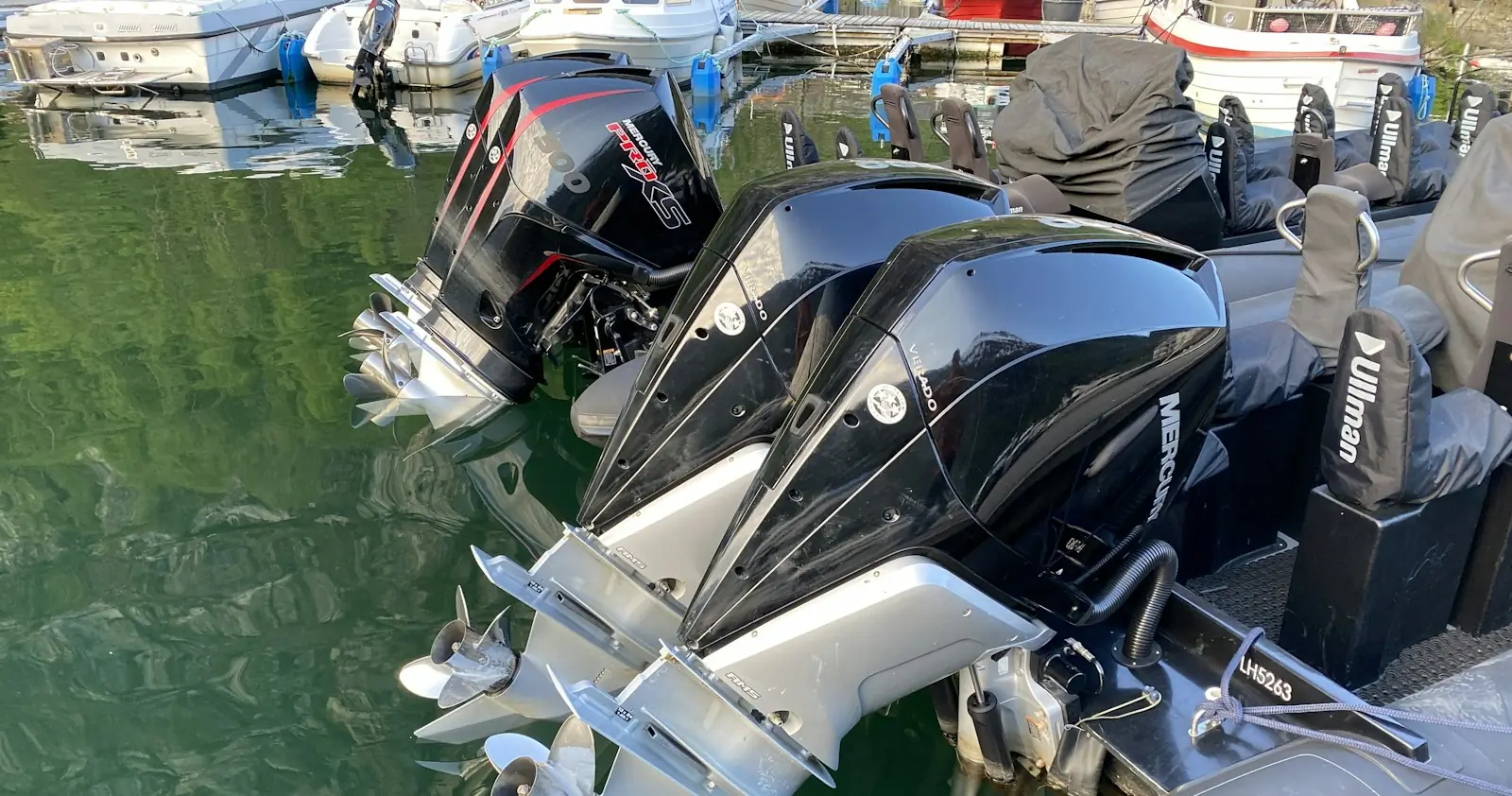
An outboard carries 6.2 or 4.2 per cent depending on cylinder capacity. The duty can be zero with substantiated origin in the United States, Japan, Norway or the United Kingdom.
Five commodity codes, five rates
What everyday language calls a boat engine is not one product in the customs tariff but several. What decides is whether the engine is outboard or inboard, whether it runs on petrol or diesel, and how large it is.
- Outboard, up to 325 cm³
- Six point two per cent. The smallest engine therefore carries the highest rate.
- Outboard, above 325 cm³
- Four point two per cent, whether the output is above or below thirty kilowatts.
- Petrol inboard
- Four point two per cent.
- Diesel marine propulsion engine
- Two point seven per cent for a leisure boat. Free only on end use in a vessel for the open sea.
- Engine parts
- Two point seven per cent, that is lower than the engine itself.
Duty rate per engine type
Two stroke or four stroke has no bearing at all on the duty rate, even though that is the difference most often discussed. What matters is the cylinder capacity and the ignition principle.
An auxiliary engine of 300 cc is taxed harder than a 2 000 cc transom engine. The line sits at 325 cubic centimetres.
Origin can remove the duty entirely
Nearly all the large engine manufacturing countries sit at zero, but only with the right evidence and only if you claim the reduction in the declaration.
- United States
- Zero since 1 July 2026. There is no certificate of origin. Instead free evidence of non preferential origin applies, plus a direct transport condition.
- Japan
- Zero since February 2020. Requires a statement on origin from the exporter, or importer’s knowledge. EUR.1 may not be used against Japan.
- Norway and the United Kingdom
- Zero with valid proof of origin under the EEA agreement and the trade and cooperation agreement respectively.
- China
- No reduction. Here it is 6.2 or 4.2 per cent.
Reduced duty by country of origin
On an engine with a customs value of 68 000 kronor the difference between 4.2 per cent and zero is just under 3 600 kronor, including the VAT effect. On a small engine at 6.2 per cent the difference is proportionally larger.
Running the numbers
VAT is twenty-five per cent and is calculated on the customs value plus the duty plus incidental costs up to your location. A large outboard from China with a goods price of 60 000 kronor and 8 000 in freight gives a customs value of 68 000. The duty comes to 2 856 kronor and the VAT to 17 714, so 20 570 to pay.
The same engine from the United States with substantiated US origin gives no duty and 17 000 in VAT. A small engine under 325 cc with a customs value of 21 000 kronor gives 1 302 in duty and 5 576 in VAT.
The engine or the whole boat?
Buy a complete boat with an engine and the whole thing is classified as a boat, with the rate following the boat's commodity code. That is one of several reasons to read the page on importing boats before you decide how to structure the purchase. It also covers the registration rules, which look nothing like the ones for cars.
Read on
It is the engine's commodity code that decides the duty rate. Read about customs classification of goods.
Common questions
Why does the small engine carry more duty than the large one?
Because the customs tariff splits outboard motors by cylinder capacity, and the line sits at 325 cubic centimetres. Below it the rate is 6.2 per cent, above it 4.2 per cent. It is counterintuitive but consistent, and it means a small auxiliary engine is taxed harder than a large transom mounted one.
What is required on the CE side?
The engine must carry a CE mark and be accompanied by a declaration of conformity. There is no such thing as a CE certificate, and asking for one gets you a worthless laboratory report at best. For outboards and sterndrives with an integral exhaust system, the declaration must cover both exhaust emission and noise requirements.
The requirement does not depend on where the engine was manufactured but on it being placed on the market within the EU. A used engine that has never been on the union market is therefore fully covered.
What happens if the engine is not correctly CE marked?
Then you as the importer take over the manufacturer's obligations. The law calls you a private importer if you bring the engine in for your own use, and you must then make sure it meets the essential requirements before it is put into service.
In practice that means a post construction assessment that only a notified body may carry out, and it has to be finished before the engine is cleared through customs. The technical documentation must be as comprehensive as if you had built the engine yourself. This is the trap that stops most imports of Japanese domestic market engines.
Do the same rules apply to electric motors?
No. The law defines a propulsion engine as an internal combustion engine, so an electric outboard is not covered by the exhaust and noise requirements of the recreational craft rules. For customs purposes it falls in a different chapter from the combustion engines, but exactly which commodity code a complete electric outboard with drive and steering belongs to cannot be settled in general. We resolve that with binding tariff information when it matters.
What applies to a used engine?
For customs purposes, nothing in particular for outboards. The commodity code does not distinguish new from used, so the rate is the same. Diesel engines, on the other hand, have their own branch for used units in the tariff.
The CE requirements still apply, because the engine is placed on the union market for the first time at import. There is an exception for products that demonstrably were within the union before the requirement came into force and are being reimported.
Does any authority keep a register of boat engines?
No. The compulsory leisure boat register was wound up at the end of 1992, and there is no register of engines. The Swedish Transport Agency is the market surveillance authority and writes the regulations, but it does not register or certify engines. Certification is done by notified bodies.
Have you tuned the engine?
Then it may matter. A modification that makes the engine exceed the established emission limits, or that increases the rated power by more than fifteen per cent, counts as a major modification and triggers a new conformity assessment.
